• Study Materials
    • InfyTQ Archive
    • Infosys Archive
    • TCS Archive
    • Accenture Archive
    • AMCAT Archive
    • Capgemini Archive
    • Cisco Archive
    • CoCubes Archive
    • Cognizant(CTS) Archive
    • Deloitte Archive
    • DXC Archive
    • Goldman Sachs Archive
    • Hexaware Technologies Archive
    • LTI Archive
    • MindTree Archive
    • Virtusa Archive
    • Wipro Archive
  • Interview Preparation
    • C Interview Questions
    • Data Structures Interview Questions
    • DBMS Interview Questions
    • HR Interview Questions
    • Java Interview Questions
    • Operating System Interview Questions
    • Python Interview Questions
    • SQL Query Interview Questions
  • Tutorials
    • Node.js Tutorial
    • Express.js Tutorial
    • Python Tutorial
  • Programming
    • C Programming MCQs
    • C Code Snippets – Output Questions
    • Python Code Snippets – Output Questions
    • Java Code Snippets – Output Questions
  • Aptitude
    • Verbal Ability for Placements
CODE OF GEEKS

We at CODE OF GEEKS, aim at providing best and quality content for our users at no extra cost.

    • Study Materials
      • InfyTQ Archive
      • Infosys Archive
      • TCS Archive
      • Accenture Archive
      • AMCAT Archive
      • Capgemini Archive
      • Cisco Archive
      • CoCubes Archive
      • Cognizant(CTS) Archive
      • Deloitte Archive
      • DXC Archive
      • Goldman Sachs Archive
      • Hexaware Technologies Archive
      • LTI Archive
      • MindTree Archive
      • Virtusa Archive
      • Wipro Archive
    • Interview Preparation
      • C Interview Questions
      • Data Structures Interview Questions
      • DBMS Interview Questions
      • HR Interview Questions
      • Java Interview Questions
      • Operating System Interview Questions
      • Python Interview Questions
      • SQL Query Interview Questions
    • Tutorials
      • Node.js Tutorial
      • Express.js Tutorial
      • Python Tutorial
    • Programming
      • C Programming MCQs
      • C Code Snippets – Output Questions
      • Python Code Snippets – Output Questions
      • Java Code Snippets – Output Questions
    • Aptitude
      • Verbal Ability for Placements
CODE OF GEEKS
CODE OF GEEKS
  • Study Materials
    • InfyTQ Archive
    • Infosys Archive
    • TCS Archive
    • Accenture Archive
    • AMCAT Archive
    • Capgemini Archive
    • Cisco Archive
    • CoCubes Archive
    • Cognizant(CTS) Archive
    • Deloitte Archive
    • DXC Archive
    • Goldman Sachs Archive
    • Hexaware Technologies Archive
    • LTI Archive
    • MindTree Archive
    • Virtusa Archive
    • Wipro Archive
  • Interview Preparation
    • C Interview Questions
    • Data Structures Interview Questions
    • DBMS Interview Questions
    • HR Interview Questions
    • Java Interview Questions
    • Operating System Interview Questions
    • Python Interview Questions
    • SQL Query Interview Questions
  • Tutorials
    • Node.js Tutorial
    • Express.js Tutorial
    • Python Tutorial
  • Programming
    • C Programming MCQs
    • C Code Snippets – Output Questions
    • Python Code Snippets – Output Questions
    • Java Code Snippets – Output Questions
  • Aptitude
    • Verbal Ability for Placements

Recursion in Python with examples | Types of Recursion

  • December 12, 2021
  • CODE OF GEEKS
  • 0

Recursion in Python refers to the concept when a function is called by itself one or more times.

Syntax

def fun():
    // statements
    fun()


Consider a scenario where we want calculate the factorial of n = 5, let’s see how it goes :

factorial(5) :
-> 5 * factorial(4)
–> 5 * 4 * factorial(3)
—> 5 * 4 * 3 * factorial(2)
—-> 5 * 4 * 3 * 2 * factorial(1)
—–> 5 * 4 * 3 * 2 * 1 = 120

Here, you must be able to catch the common pattern.

So, recursive formula to calculate factorial of any number ‘n’ is given as :

factorial(n) = n * factorial(n-1)

Here, function factorial() is calling itself with different values of ‘n’.

One thing to note is that every recursive function requires a break-down condition. A break-down condition is a condition which breaks down the program flow once intended purpose is completed.

If recursive function, does not have any break-down condition then, it will become an infinite loop.

Program : To calculate the factorial of a given number using recursion

def factorial(n):
    if n == 1: # break-down condition
        return 1 
    else: 
        return n * factorial(n-1)
print(factorial(5))      

Above function factorial() evaluates the factorial of 5.

if n == 1 : 

Above line is a break-down condition. This means that program flow will stop when ‘n’ becomes 0 and final value is returned.

Let’s try to break this :
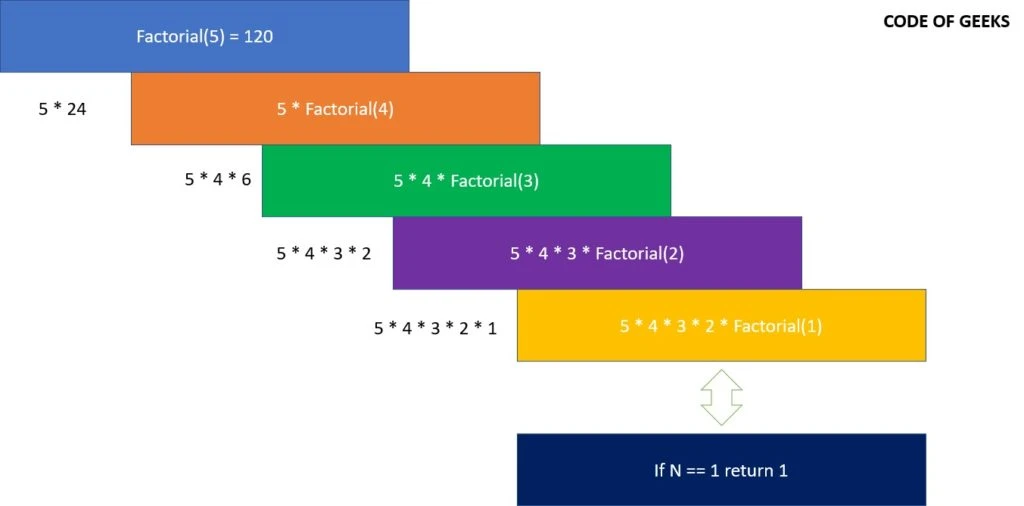
factorial of a number in python


Recursion has two phases :

1. Winding Phase : This phase runs until desired condition is fulfilled.

2. Unwinding Phase : Once winding phase gets over, control is transferred back to original call, this is unwinding phase.

Types of Recursion in Python

Recursion in Python is of two types :

1. Direct Recursion

2. Indirect Recursion

Let’s explore them one-by-one

Direct Recursion

Direct Recursion is a type of recursion in which a function explicitly calls itself, usually with a different set of values. It is further divided into 3 types :

1. Tail Recursion

2. Non Tail Recursion

3. Tree Recursion

Tail Recursion

Tail Recursion occurs if a recursive function calls itself and the function call is the last statement to be processed in the function before returning having reached the base case. After processing the call, function returns control back to the parent function call.


Program : To print counting from 1 to 10 with the help of tail recursion.

def counting(n):
    if n == 11: # break-down condition
        return  
    else: 
        print(n)
        counting(n+1)
counting(1)     

O/P

1
2
3
4
5
6
7
8
9
10

In the above code, function counting() has a recursive call as a last statement. Here, the program will terminate when
n = 11, this is the break-down condition or also known as base condition of a program.

Order of Execution : print(1) -> counting(1) -> print(2) -> counting(2) -> print(3) -> counting(3) -> print(4) -> counting(4) -> print(5) -> counting(5) -> print(6) -> counting(6) -> print(7) -> counting(7) -> print(8) -> counting(8) -> print(9) -> counting(9) -> print(10) -> counting(10) -> n == 11


Non Tail Recursion

Non Tail Recursion occurs if a recursive function calls itself and the function call is not the last statement to be processed in the function. In non tail recursion, there are some operations executed even after the recursive call.

Program : To print counting from 1 to 10 with the help of non tail recursion.

def counting(n):
    if n == 0: # break-down condition
        return  
    else: 
        counting(n-1) # recursive call is not the last statement
        print(n)
counting(10)     

O/P

1
2
3
4
5
6
7
8
9
10

In the above code, function counting() has a recursive call but not as a last statement. Here, the program will terminate when
n = 0, this is the break-down condition or also known as base condition of a program.

Order of execution :

counting(10) -> counting(9) -> counting(8) -> counting(7) -> counting(6) -> counting(5) -> counting(4) -> counting(3) -> counting(2) -> counting(1) -> n == 0 condition satisfies -> Now print statement will come into picture.

counting(1) will return 1, counting(2) will return 2, counting(3) will return 3 and so on.


Tree Recursion

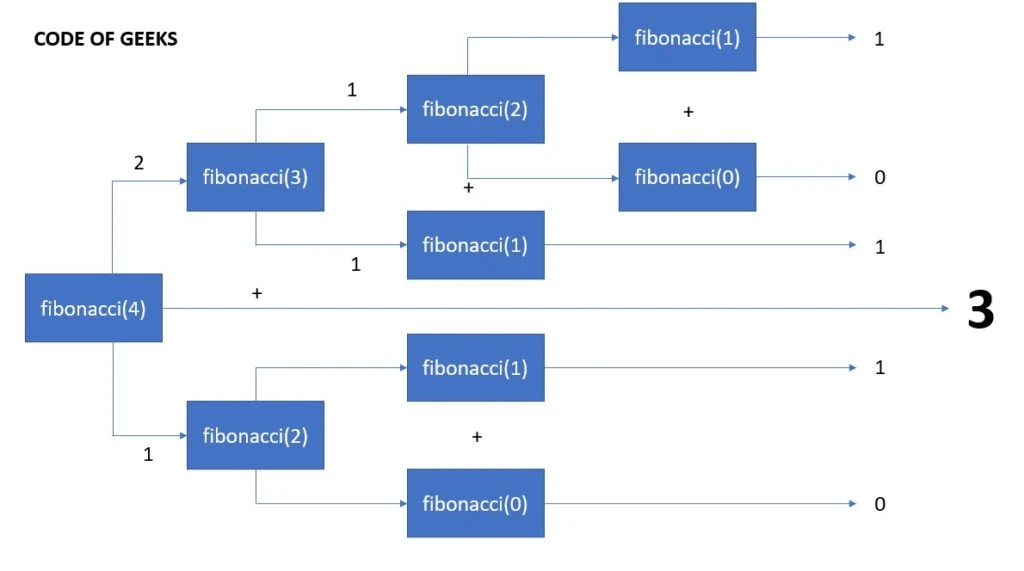
Tree Recursion in Python is a type of recursion in which a function is called two or more times in the same function.

Program : To print n-th term of fibonacci series (1 1 2 3 5 8 13 21 …) in Python using Tree Recursion.

def fibonacci(n):
    if n == 0:
        return 0
    if n == 1:
        return 1
    return fibonacci(n-1) + fibonacci(n-2)
print(fibonacci(4))     

O/P : 3

Order of Execution : Please refer to the below image in order to trace the execution


Indirect Recursion

Indirect Recursion is a type of recursion where two or more functions are involved in mutual-invocation. This means that, if function fun1() calls another function fun2() and, fun2() calls fun1() again, then this is termed as indirect recursion.

def fun1():
    # statements 
    fun2()
def fun2():
    # statements 
    fun1() 

Program : To implement Indirect Recursion

def fun1(a):
    if a % 2 == 0:
        print(a) 
        return 
    a += 1
    fun2(a)
def fun2(a):
    if a % 2 == 0:
        print(a) 
        return
    a += 2
    fun1(a)
fun1(11)    

O/P : 12

In the above program, our task is to terminate the program when ‘a’ becomes even.
Function fun1() increments value by 1 then calls fun2() and function fun2() increments value by 2 then calls fun1().


Application of Recursion in Python

Recursive algorithms are usually shorter and are used to solve many complex real world problems. Some of them are :

  1. Postfix, Prefix, Infix Conversion
  2. Tower of Hanoi
  3. Parenthesis Matching
  4. N-Queen’s Problem
  5. Depth First Search, Breadth First Search

Recursive Algorithms have higher runtime complexities.

Difference between Iteration and Recursion

RecursionIteration
Recursion achieves repetition through repeated function calls.Iteration explicitly uses repeated structure.
Recursion terminates when base case is recognized.Iteration terminates when loop condition fails.
Recursion returns a value to the calling function.Iteration does not return any value.
Recursion makes a code smaller.Iteration makes a code larger.
Recursion is a slower process than iteration.Iteration is faster.

That’s all about Recursion in Python.


Tags: direct recursion pythonindirect recursion pythonnontail recursionrecursion in pythonrecursion pythontail recursion python
  • Previous Lambda Functions in Python with example | filter(), map(), reduce() in Lambda
  • Next Local & Global Variables | Global Keyword in Python

Leave a Reply Cancel reply

Your email address will not be published. Required fields are marked *

Advertise with us

Table of Content – Python

  1. Introduction to Python ▼
    • Python and its features
    • Key Differences : C vs Python
    • Key Differences : Java vs Python
    • Python Flavors
    • PVM and Memory Management in Python

  2. Python Fundamentals ▼
    • 'Hello World' using Python
    • Comments in Python
    • Variables and Garbage Collection in Python
    • Datatypes in Python
    • Determining the Datatype of Literal | type() method
    • Tokens in Python
    • Keywords in Python
    • Identifiers and Naming Convention in Python
    • Literals in Python

  3. Python Operators ▼
    • Operators in Python
    • Python Mathematical Functions

  4. Python User Inputs ▼
    • Taking Inputs | input() function in Python

  5. Python Control Statements ▼
    • Control Statements in Python
    • if-elif-else Statements in Python
    • Looping in Python
    • while loop in Python
    • while-else loop in Python
    • for loop in Python
    • for-else loop in Python
    • Infinite loops in Python
    • Nested loops in Python
    • break Statement in Python
    • continue Statement in Python
    • pass Statement in Python
    • assert Statement in Python
    • return Statement in Python

  6. Python Functions ▼
    • Introduction to Python Functions
    • Python Functions vs Python Methods
    • Local and Global Variables in Python
    • Formal and Actual Arguments in Python
    • Recursion in Python Functions
    • Lambda Functions in Python
    • Function Decorators in Python
    • Function Generators in Python

  7. Python Strings ▼
    • Strings in Python and Basic Operations
    • String Immutability Explained
    • strip() method in Strings
    • find() method in Strings
    • count() method in Strings
    • replace() method in Strings
    • split() method in Strings
    • Switching Cases in Strings
    • startswith() method in Strings
    • endswith() method in Strings

  8. Python Lists ▼
    • Python Lists Basics
    • index() method in list
    • append() method in list
    • insert() method in list
    • copy() method in list
    • remove() method in list
    • pop() method in list
    • sort() method in list
    • reverse() method in list
    • clear() method in list
    • Nested Lists in Python
    • List Comprehensions in Python

  9. Python Sets ▼
    • Python Sets and Basic Operations
    • Adding Elements in Python Sets
    • Removing Elements in Python Sets
    • Union in Python Sets
    • Intersection in Python Sets

  10. Python Tuples ▼
    • Python Tuple Basics
    • Python Tuples Immutability Explained
    • Python Tuples Methods
    • Python Nested Tuples

  11. Python Dictionary ▼
    • Python Dictionary Basics
    • Python Dictionary Sorting
    • Python Dictionary List to Dictionary Conversion
    • Passing Dictionary to Function

  12. Python Classes and Objects ▼
    • Classes and Objects
    • self variable in Python
    • __init__() method in Python
    • Inner Classes
    • Instance variable and methods
    • Class variable and methods

  13. Python OOPs ▼
    • Inheritance and its types
    • super() method in Python
    • Abstract class| Abstract method in Python

  14. Python Exception Handling ▼
    • Errors in Python and its types
    • Exception Handling in Python
    • Types of Exceptions in Python
    • Custom Exceptions in Python

  15. Python File Handling ▼
    • File Handling in Python
    • with statement in Python

  16. Python DateTime Modules ▼
    • datetime module in Python

  17. Python MultiThreading ▼
    • Multithreading in Python

  18. Python Requests Module ▼
    • Python GET Request
    • Python POST Request
    • Python PUT Request

Python Programs

  1. Fibonacci Series till 'N' Numbers

  2. Sum of Digits of a Number

  3. Checking Prime Number

  4. Checking Armstrong Number

  5. Finding Reverse Number (Traditional)

  6. Finding Reverse Number (Pythonic)

  7. Finding Prime Numbers within Range

  8. Finding Prime Numbers within Range Using SOE

  9. Checking Leap year

  10. Calculating Simple Interest

  11. Generate Random Numbers

  12. Calculate Compound Interest

  13. Area of Circle

  14. ASCII Value of Character
CODE OF GEEKS

Subscribe to Newsletter

CODE OF GEEKS

Learn | Code | Achieve

Reach us

[email protected]
We at CODE OF GEEKS, aim at providing quality content to our users at no cost.
CODE OF GEEKS

Important Pages

About us
Advertise
Privacy Policy
Terms and Conditions
Refund Policy
Contact us

Placements – Study Materials

TCS NQT     Wipro     CapGemini
Accenture     MindTree     CTS
DXC     Hexaware Technologies     AMCAT
CoCubes     Goldman Sachs     Dell
Cisco     Deloitte     Virtusa     LTI     Infosys   

Tutorials

Python
Node.js
Express.js
Golang

Recent Posts

Strings in Go and its basic operations
  • August 11, 2023
Introduction to Functions in Go programming
  • August 11, 2023

Copyright @ CODE OF GEEKS. All Rights Reserved.